


This article contains general information and is not intended to provide information that is specific to American Express, or its products and services. Similar products and services offered by different companies will have different features and you should always read about product details before acquiring any financial product.
It’s no secret that the commercial world is currently experiencing pronounced and ongoing labor shortages that are deeply impacting the shape of business operations. Concerns prompted by worker shortages and hiring, as well as retention issues, also continue to vex firms’ productivity and performance.
Thankfully, understanding the root causes and employment trends that are behind the current labor shortage can help you get a better handle on what’s happening from an operational and strategic planning standpoint. Likewise, a variety of helpful HR and staffing strategies can help your company become more agile, flexible, and resilient about adapting to rising issues in turn. Let’s take a closer look at what’s prompting recent labor shortages, whether they’re expected to continue for the foreseeable future, and what you can do to respond effectively when faced with hiring concerns.
What Is a Labor Shortage?
Labor shortages refer to periods of time during which job markets have considerably more open positions than people to fill them. Sectors such as technology, manufacturing, health care, and education often struggle to find enough skilled workers to staff positions. Customer-facing businesses such as restaurants, retailers, and service providers may also find it difficult to recruit and retain both front-end workers and operations or logistics professionals during such times.
Companies should have enough skilled staff on hand to keep their doors open, and labor shortages make it hard for organizations to do what they do best, not to mention compete with rival firms.
No matter your chosen field or the size of your firm, you can potentially be impacted by a labor shortage crisis. Not having enough employees can lead to a backlog of work, project delays and errors, operational inefficiencies of all kinds, and a plethora of additional concerns. As a result, it’s important to be aware of how to effectively adapt in the face of downturns in hiring.
Why Do Labor Crises Happen?
Worker shortages lead to a labor crisis when manpower is hard to come by for essential positions or an assortment of other job roles en masse. Sometimes it’s difficult to find skilled candidates with expertise in a particular role or field of work. Other times, salary levels and benefits programs struggle to keep up with inflation or new employee demands. Certain regions may further lack access to a wide pool of local talent, or struggle to attract new hires for an assortment of economic or geopolitical situations. As we saw during the pandemic, rising health concerns and demand for flexible living arrangements may also lead to worker shortages on a mass scale.
Whatever the cause, a labor crisis presents significant cause for concern. A labor crisis can create potential skill shortages for businesses, mismatches in finding the right hires, and greater competition for every position. That presents a wealth of potential headaches for employers, even before considering rising instances of job-related stress and burnout among workforces who may feel discontented and overworked.
According to the "Recruitment Survey Report: Tactics and Strategies for Winning Hard to Find Talent in 2024," an October 2023 survey of 200 recruiters and talent acquisition professionals by SmartRecruiters and TalentBoard, it’s taking 60% of respondents longer on average to fill positions than it did just a year ago. Respondents also report that leading challenges facing staffers include finding reliable hiring sources, job candidates ghosting or accepting other offers, an overall drop-off rate in application volume, and a lack of diversity in prospective candidates.
Understanding the Gap
Analyses by the U.S. Chamber of Commerce reveal that many job openings now exist. However, the agency also reports that the overall proportion of America’s population that is participating in the labor force has shrunk, and that the U.S. does not have enough skilled workers to fill these positions. In fact, just 62.7% of Americans are participating in the current job market. According to the Chamber, this means that workforce participation is still clocking in at below pre-pandemic levels, to the tune of 1.7 million workers missing from the U.S. workforce compared to February 2020.
As for why prospective employees aren’t dipping their toes back into the job market, reasons are manifold. The Chamber of Commerce report found that some have retired, others have made the switch to part-time vs. full-time work, and a number of individuals have transitioned into becoming full-time homemakers. But a number of Americans also cite an unwillingness to take on jobs that do not allow for the flexibility of remote work as well, and some are prioritizing personal growth or acquiring new skills, training, and education before stepping back into the job market. Whatever the reasons for not returning to work, it all adds up to an ongoing worker shortage that business owners and operators are being forced to address.
To put things in perspective: Per global human resource consulting firm Randstad’s Workmonitor report, which surveyed 27,000 international workers between October and November 2023:
- 93% of employees now consider work-life balance as important as pay on their list of priorities.
- 72% of employees want roles that provide training in emerging areas automation, and information technology.
- 55% believe that they cannot show their fully authentic selves at work.
- 38% seek alignment on environmental and social issues from prospective employers.
- 37% would consider quitting if they were asked to spend more time in the office.
Labor Shortage Risks
Naturally, the U.S. labor shortage, like assorted international workforce crises, presents a growing number of areas of concern for businesses and business leaders in every field. Just a few issues that you may have already encountered include reduced operating hours, lack of parts and products, and temporary or permanent store or restaurant closures. Challenges can also have a dampening impact on innovation and a firm’s ability to compete or future-proof its business for tomorrow’s market.
How Labor Shortages Impact Businesses
A worker shortage can have negative effects on a company’s capacity to conduct, improve, or expand business operations. Companies should have enough skilled staff on hand to keep their doors open, and labor shortages make it hard for organizations to do what they do best, not to mention compete with rival firms. To put things in perspective, 2024 Talent Trends, a January 2024 poll of 2,366 HR professionals by the Society for Human Resources Management (SHRM), notes that:
- More than 3 of every 4 organizations have recently had difficulty recruiting staff for full-time positions.
- Almost half have experienced challenges retaining full-time employees who are already on their payroll.
- 47% of HR pros note that it’s become more difficult to recruit for positions than it was a year ago.
Between fewer applications for positions, more competition from competitors, and a jump in candidates who “ghost” or disappear on them, firms are having trouble hiring for everything from hourly laborers to service workers. That makes it extremely difficult to keep up in areas like performance, productivity, customer service, and quality controls, and fewer workers recruited and retained means that companies can struggle to maintain current output levels, let alone expand and grow.
How Your Business Can Adapt to Labor Shortages
There are steps you can take as a business leader to offset current and future job market concerns.
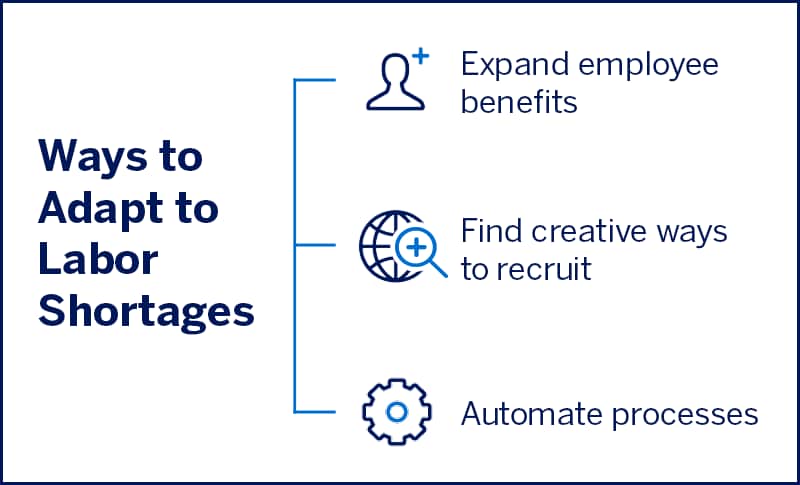
- Offering more work-life balance and benefits: Consider offering more flexible shifts and roles, increasing wages and benefits packages, instituting reskilling and upskilling courses, or reducing work hours or days.
- Embracing technology: Try optimizing and automating processes and workflows, switching to online sales, using smart scheduling and inventory management tools, and turning to online, pay-as-you-go providers.
- Rethinking your recruitment strategy: Consider introducing apprenticeships or internships, hosting recruitment fairs, expanding hiring efforts to international markets, and hiring freelance or temp workers.
How to Maintain Your Workforce During a Labor Shortage
Labor shortages may continue to be more of a concern for business owners and operators going forward. Thankfully, just by making a point to plan ahead more proactively, you can help your business to stay one step ahead of a labor crisis, and understanding how to maintain your workforce during a labor shortage can help you offset any downturns that you may encounter.
Photo: Getty Images
The material made available for you on this website is for informational purposes only and is not intended to provide legal, tax or financial advice. If you have questions, please consult your own professional legal, tax and financial advisors.