English | Suomi
Scams, phishing and online safety
We are happy to share some simple and effective ways to protect yourself online. Our tips
will show you how to avoid scams, spot phishing emails and stay safe online.
Suspecting fraud? Please contact Customer Service immediately →
Phishing emails, suspicious letters and SMS fraud
Email phishing or smishing is when a fraudster tries to get passwords or verification codes by email, SMS or WhatsApp that appears legitimate at first. Always be careful when you see a message from recipients you don't recognize.
Have you received correspondence from us to identify yourself?
It is indeed possible that we ask you to identify yourself. This arises from the Anti-Money Laundering and Anti-Terrorist Financing Act (AML), which obliges us to regularly check your data. Please find out more at our AML support webpage, found here
How to spot a phishing email or SMS fraud:
- You are prompted to take quick action;
- The e-mail or SMS is not personal, with a salutation such as 'dear cardholder' or 'dear customer';
- There is a link in the email or SMS that will take you to a counterfeit website. Check if you could recognize the URL as an American Express URL by hovering your mouse
cursor over the link; - The email contains spelling errors.
How to protect yourself from phishing or smishing:
- Do not provide your PIN, password, login details or card details;
- Don't provide a verification code if you didn't expect it, even if it's from American Express;
- Keep your antivirus software up to date and install a firewall;
- Make sure your spam filter is turned on.
How to check if it's a legitimate American Express email:
Check the sender's address. We normally email you from these addresses:
- @americanexpress.com
- @aexp.com
- @americanexpress.fi
- @aexpfeedback.com
- @member.americanexpress.com
- @email.americanexpress.com
- @welcome.aexp.com
- @alerts.americanexpress.com
- @response.americanexpress.com
- @eapp.americanexpress.com
Website scams
Fraudsters can create a fake website that appears legitimate to trick you into entering your personal information, such as your password or PIN. Find out how to check if a website is legit.
How to check if a website is legit:
- The web address must start with 'http' and end with 's': 'https: //' - the 's' stands for secure;
- There should be a padlock icon in the browser's address bar;
- In some browsers, the address bar or company name is green.
- All American Express URLs start with: www.americanexpress.com
How to protect yourself from a website scam:
- Log out of every site, every time you have registered your details. Just closing the browser is not enough;
- Choose strong, unique passwords (for example, not your child's birthday);
- Keep your antivirus software up to date and install a firewall;
- Hover over the URL to make sure it's the same as in an email or search engine before clicking it.
How to check if it is a legit American Express website:
Please check the URL, our websites normally start with:
- https://americanexpress.com
- https://americanexpress.fi
Phone fraud
Fraudsters can call 'on behalf' of American Express. This can also be done through 'spoofing', where a fraudster presents his number as ours. They will often ask for personal information, such as your account information or a verification code (something we would never do). Find out how to protect yourself against it.
How to spot phone fraud:
- Someone calls you to confirm your account information;
- Someone calls you to ask for your PIN, card details and/or card security code;
- Someone calls you to request a verification code that you just received by email or text;
- They ask you to act urgently (e.g. tell your account to be suspended or closed unless you act immediately).
How to protect yourself from phone scams:
- Never give out your account details or verification codes by phone;
- We will never ask for the 4-digit or 3-digit security code on your card;
- If something doesn't feel right, just hang up and call us at the number on the back of your card.
How to check if American Express is calling you:
- When we call you, we will only ask security questions that require partial answers;
- We will never ask you for your PIN or password;
- We will never ask for the 4-digit or 3-digit security code on your card;
- If we call you, we will not send you a verification code via email or text and ask you to confirm it by phone;
- If something doesn't feel right, just hang up and call us at the number on the back of your card.
Report phone fraud
Contact American Express Customer Service directly if you believe you have been the victim of telephone fraud. We are here to help and protect you.
How we keep your account safe
Fraud Protection Guarantee
Use your card without any worries, wherever you are. At American Express, you will not be held responsible for fraudulent transactions as long as you have taken reasonable care to protect your account information and PIN from any device on which you have registered your account information.
Account and Fraud Notifications
If we discover something unusual on your account, we will contact you immediately via text, email or phone call and assist you.
Hulp nodig? Ask Amex.
Live chat in de Amex App. 24/7. Engelstalig.
Chat live met onze Ledenservice over kaartgerelateerde vragen en aanpassingen in uw account.


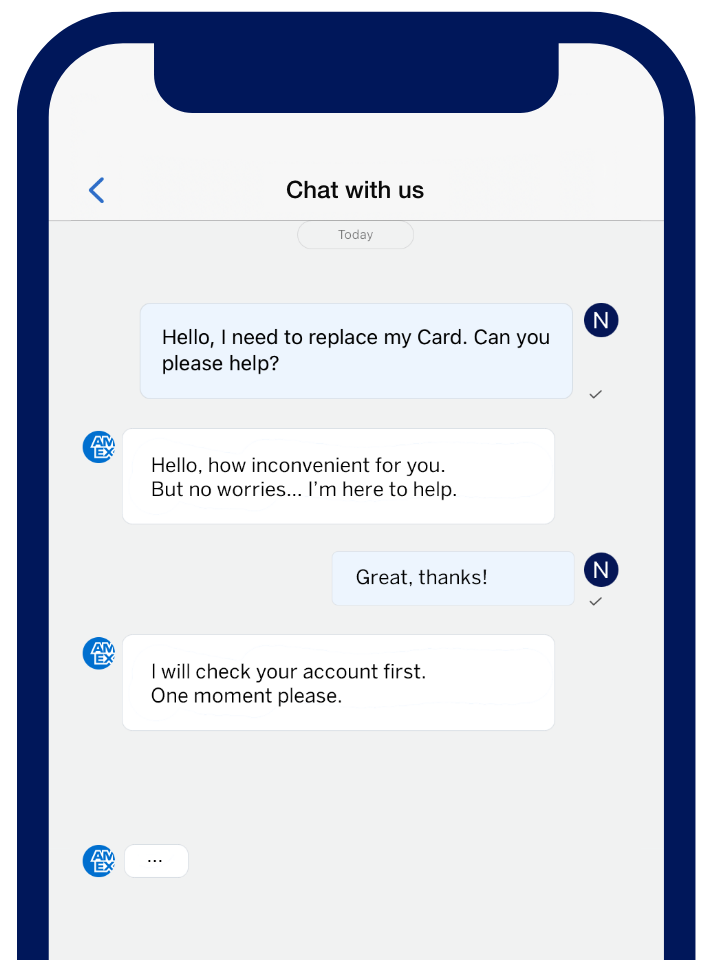
Altijd uw belangrijke kaartinformatie bij de hand
Ask Amex, de live chat, is inbegrepen in de Amex App.
- Live chat met onze Ledenservice.
- Bekijk recente rekeningoverzichten en transacties.
- Blokkeer uw kaart, bij kaartverlies of diefstal.
- Bekijk of wijzig uw pincode.
- Betaal met punten (Pay with Points).


AMERICAN EXPRESS
Copyright © 2025 American Express Company