


How Much Should You Have in an Emergency Fund?
6 Min Read | Last updated: March 15, 2026

This article contains general information and is not intended to provide information that is specific to American Express products and services. Similar products and services offered by different companies will have different features and you should always read about product details before acquiring any financial product.
Understand what an emergency fund is, how to build one, how much to save, and which accounts keep your money secure and accessible.
At-A-Glance
- An emergency fund is a surefire way to help manage unexpected expenses.
- Exactly how much you should have in your emergency fund depends on your present—and hypothetical future—financial needs.
- It’s okay to start slow and steady, but ultimately it’s a good idea to set aside three to six months’ worth of expenses.
Someone once said, “Life is like a box of chocolates.” Except I’d argue that chocolate is a lot more pleasant than some of the monkey wrenches life can throw at us. While unexpected expenses are a reality of life, they don’t always have to be burdensome or stressful. An emergency fund can make life a lot easier to manage when facing a furlough or a fridge on the fritz.
Yet only about 12% of American adults could cover the cost of a $1,000 car repair or emergency room visit using savings, according to data from a March 2025 survey. The same survey reports that 19% of people surveyed had less than $100 saved.1
An emergency fund can help us weather such unexpected financial storms. But how much should you have in your emergency fund, and where should you keep it?
What Is an Emergency Fund and Why Should You Have One?
An emergency fund is money set aside in an easily accessible savings account to help you more comfortably manage major unexpected expenses. This means unlikely extenuating circumstances and financial emergencies—a job loss, an injury, a broken furnace—not a new bike, a vacation, or routine bills. Ideally, you never want to need your emergency fund.
But if you never want to use it, why have it? If you face a major unanticipated expense or an unpredictable shift in your income without the cushion of an emergency fund, you may have to cover costs with a credit card or even take out a loan. This means you’ll be in debt, and may have to pay more than the initial cost to overcome the emergency due to interest charges.2
How Much You Should Have in an Emergency Fund
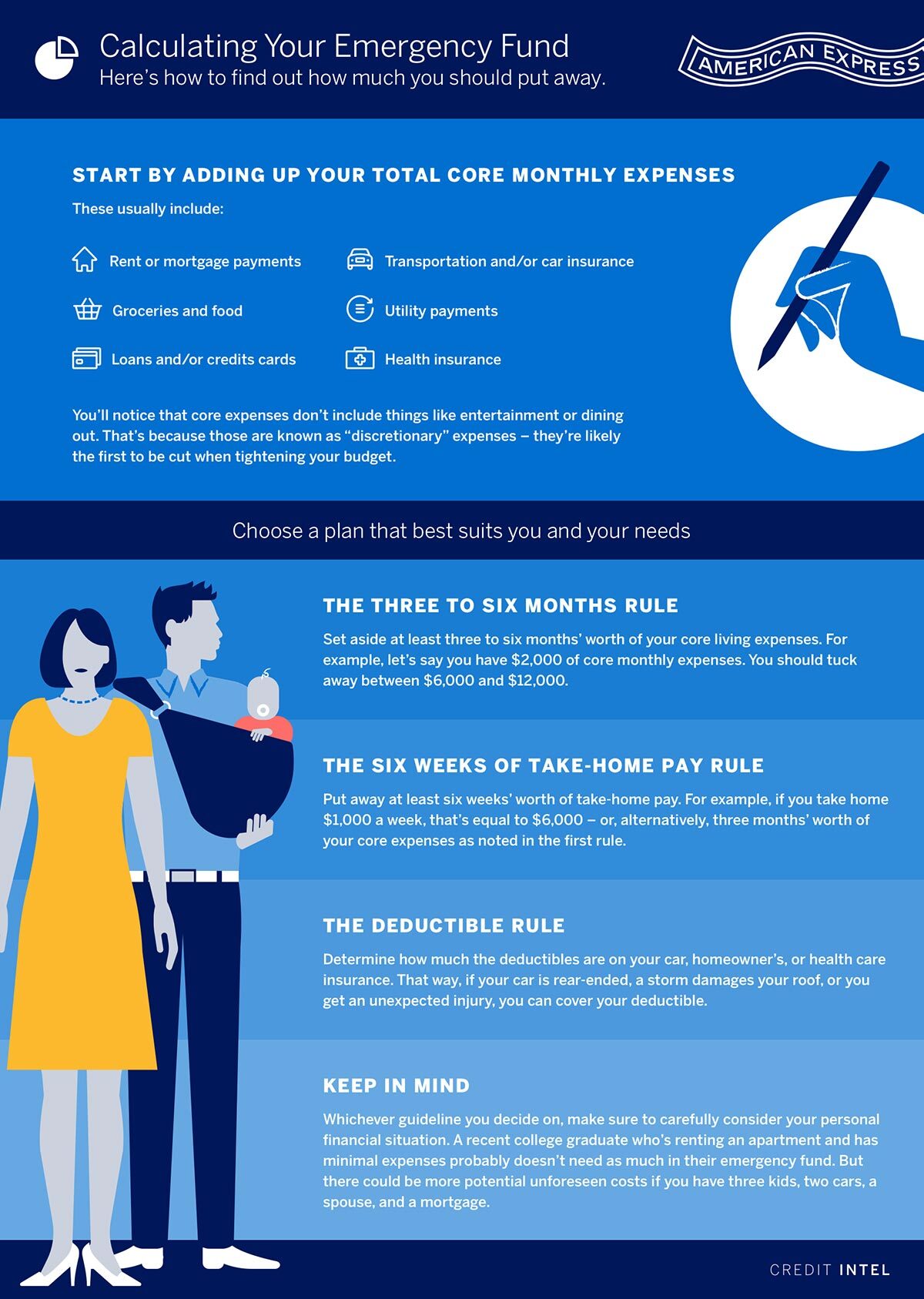
How much you should have in your emergency fund needs to match your fixed—and hypothetical—financial needs.2 To get started, calculate your total core monthly expenses. This usually includes:
- Rent or mortgage payments
- Groceries and food
- Utility payments
- Transportation and car insurance
- Health insurance
- Loans and/or credit cards
Note that the list of core expenses does not include things like entertainment, shopping sprees, or dining out. That’s because they’re “discretionary” expenses—the things that are likely to be cut first when tightening your budget.3
Now, let’s say your core expenses add up to $2,000 a month. To really zero in on how much you should have in your emergency fund, there are a few ways you can think about it:
The three to six months rule: The commonly suggested rule of thumb is to set aside at least three to six months’ worth of your core living expenses.3 With $2,000 of core monthly expenses, this means you should aim to tuck away between $6,000 and $12,000.
However you decide how much you should have in your emergency fund, be sure to carefully consider your particular financial situation. A recent college graduate who’s renting an apartment and has minimal expenses probably doesn’t need as much in their emergency fund. But there are a lot more potential unexpected costs if you have three kids, two cars, a spouse, and a mortgage.
Ultimately, it doesn’t really matter how you choose to conceptualize how much you should have in your emergency fund—as long as you have one.

How to Build Your Emergency Fund
If building up anywhere between three and six months of savings seems like a lot, it’s okay to consider the range as a rough guideline. The most important thing is to start saving if you haven’t already. That way you can cover a small unexpected expense like a damaged cell phone or a car repair. Start saving little by little. Even $20 a week can add up over time.
But do the math: if you’re saving only $20 a week, it’ll take almost six years to save $6,000. While slow and steady is a great start, you’ll need ways to boost momentum if you want to build your emergency fund fast. To kick your emergency savings into gear, consider:
- Depositing some or all of your tax refund into your emergency fund2
- Adding any windfall money, whether it’s a salary bonus or a $20 bill found in an old coat pocket
- Having a yard sale to sell some items you no longer need
Where to Put Your Emergency Fund
An emergency fund needs to be easily accessible.2 One of the best places to keep your emergency fund is in a high-yield savings account.3 They’re easy to open, accessible, and generally offer better interest rates than you would get with a traditional bank account—and way more than stashing your emergency fund in a piggy bank or a shoebox.
Try not to rely on a 401(k) or traditional IRA for your emergency fund. While you can access your contributions before you turn 59½ years old, you’ll usually have to pay a 10% penalty and income tax on the money you withdraw.4,5
The Takeaway
If one day it starts raining—and it doesn’t quit for four months—an emergency fund can help keep your days a little bit brighter and a little less burdensome than they would be otherwise. Even if stockpiling several months’ worth of expenses seems like a lot, remember that a little every week can add up over time, too.
1 “How much does the average American have in savings?,” YouGov
2 “An essential guide to building an emergency fund,” Consumer Financial Protection Bureau
3 “Is $5,000 Enough for an Emergency Fund?,” Experian
4 “Publication 590-B (2025), Distributions from Individual Retirement Arrangements (IRAs),” Internal Revenue Service
5 “401(k) plan hardship distributions - consider the consequences,” Internal Revenue Service


Megan Doyle is a business technology writer and researcher whose work focuses on financial services and cross-cultural diversity and inclusion.
All Credit Intel content is written by freelance authors and commissioned and paid for by American Express.
Related Articles

How Much Should You Save Each Month?
Calculate how much to save each month based on your income, and discover realistic saving strategies that still leave room to spend.

How to Manage Your Money Better
Explore smart money management strategies to master your finances: budgeting, saving, and paying bills on time to improve your financial health and future.

What Is Financial Planning?
What is financial planning? It looks different for everyone, but it starts with knowing where your money goes and where you want to be.
The material made available for you on this website, Credit Intel, is for informational purposes only and intended for U.S. residents and is not intended to provide legal, tax or financial advice. If you have questions, please consult your own professional legal, tax and financial advisors.