


How to Get Out of Debt
7 Min Read | Last updated: July 10, 2026

This article contains general information and is not intended to provide information that is specific to American Express products and services. Similar products and services offered by different companies will have different features and you should always read about product details before acquiring any financial product.
Take control of your finances with practical steps on how to reduce debt, including budgeting tips, effective repayment strategies, and smart ways to manage credit.
At-A-Glance
- Using a debt repayment strategy, such as the snowflake, snowball, or avalanche method, may help you get out of debt.
- Determining your current financial state and the amount you can commit to debt reduction is an essential first step.
- Debt consolidation can be an effective way to supercharge your debt reduction strategy.
If you’ve been watching your credit card balances climb and aren’t sure how to get out of debt, you’re not alone. In the third quarter of 2025, approximately 174 million borrowers carried an average credit card debt of $6,523 per borrower, according to the latest data from TransUnion.1 No matter what circumstances led you to high balances, it’s entirely possible to get out of debt. Employing sustainable strategies and following proven steps to get out of debt helps you stay the course during your debt elimination journey, even when you encounter challenges. While financial emergencies or a loss of motivation may throw you off track, returning to these steps and best practices can help you stay committed to your goals.
Step 1: Gather Debt Information
The first step to getting out of debt is understanding exactly what debts you need to pay off. Start by cataloging all the debts you’re carrying, including student loans, credit card balances, retail store balances, personal loans, and auto loans. For each loan or line of credit on your list, gather the following information:
- Lender’s name
- Payoff amount
- Interest rate
- Monthly due date
- Expected payoff date (for loans)
- Minimum monthly payment
From here, you can calculate the total debt amount and the total minimum payments you need to make each month to stay current.
Step 2: Factor in Interest Rates and Repayment Terms
Before deciding how to allocate your monthly budget toward your debts, it’s important to prioritize which ones to reduce first with extra payments. You may want to consider these factors as you assess your debt priorities:
- High Interest Rates
Debts with the highest interest rates may be more impactful options to pay down first. - Low or No-Interest Promotions
Debts with a low-interest or zero-interest promotion in effect should be prioritized to save money on interest before the zero-interest period ends. - Repayment Terms
Debts with set repayment terms and interest rates that don’t change may take a back seat to revolving debts like credit cards. - Secured vs. Unsecured
Secured debts (such as auto loans, home equity loans, or mortgages) typically have lower interest rates and fixed terms. Unsecured loans don’t require collateral and typically carry higher interest rates, which may put them higher on your priority list.
Step 3: Design a Debt-Focused Budget
How much money can you afford to put toward paying off debt? There are several ways you can figure out the amount that’s best for you. Start by gathering your monthly income and expenses via your bank’s online system. Then separate essential costs (such as groceries, housing, utilities, and transportation) from discretionary spending (including expenses like entertainment, dining out, and impulse buys). When you’re done, you should have three categories of monthly financial data going back 12 months:
- Income
- Essential expenses
- Discretionary expenses
To simplify, create monthly averages for your income and both expense categories. Next, review your discretionary expenses and try to eliminate anything you could do without. Nix subscriptions you no longer use, lower unnecessary spending, or switch to less expensive alternatives. The money you save here can help you pay off your debt faster.
That may mean some lifestyle changes, but it also should include a reality check. For example, if you know you can realistically commit to $450 each month to debt repayment, start with that rather than a higher number that’s more challenging to maintain long-term.
It may be easier to stay on the right track when you have the satisfaction of successfully following your plan. So, as you’re building your budget, pick a debt-paydown amount that is meaningful and sustainable. If you find that the amount you can reasonably afford won’t have a meaningful impact on your debt, you may consider a personal loan for debt consolidation (see Step 5).
Step 4: Consider the Wintry Mix: Snowflake, Snowball, and Avalanche
With a clear financial picture and a dedicated debt-payoff amount in mind, it’s time to make a plan. These three popular debt reduction strategies can be referred to as the “wintry mix”:
- Snowflake
The snowflake method uses small bits of “found money” like the forgotten $20 bill in a jacket pocket and the change at the bottom of your couch, to pay down your debt. It may sound a little silly, but it can work. - Snowball
The snowball method targets paying off debt from smallest amount to largest, regardless of interest rate. The idea is that the satisfaction of eliminating an entire debt motivates you to maintain your getting-out-of-debt discipline. - Avalanche
The avalanche method targets the loan or credit card balance with the highest interest rate first. Once that’s paid off, you refocus on the balance or loan with the next highest interest rate. Since interest charges accrue on all outstanding debt every month, paying off the debt with the highest interest rate first can save you money.
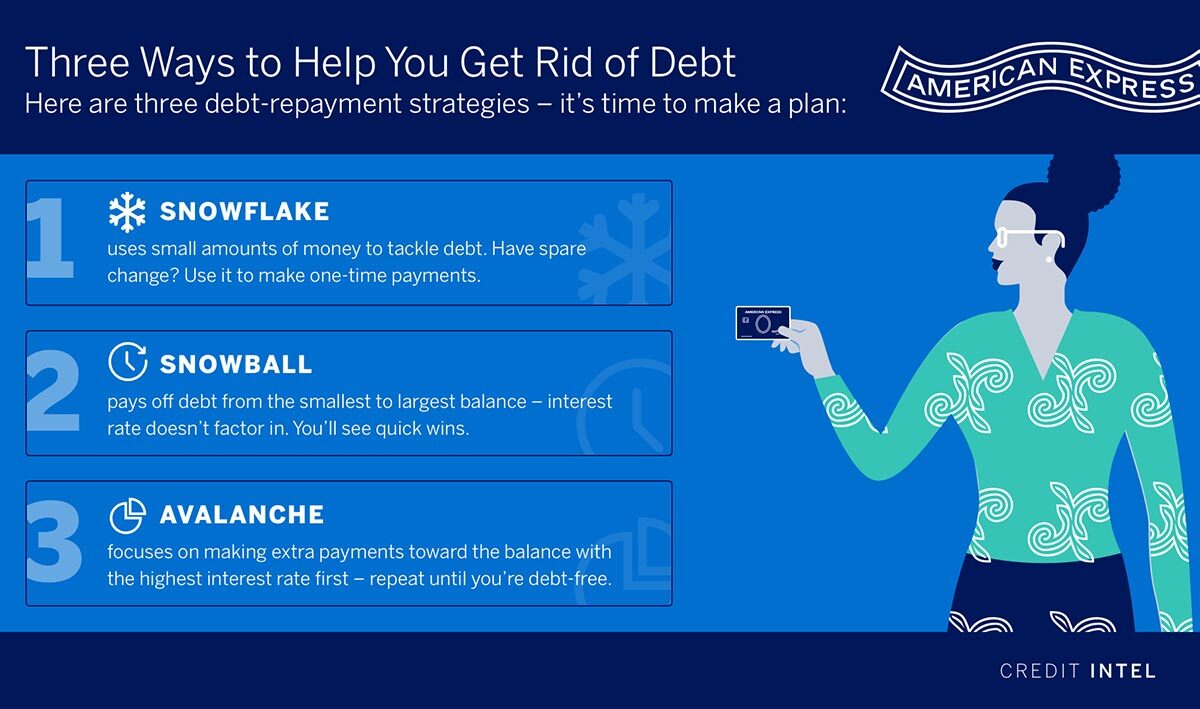
Of course, you can also combine the snowflake method with either of the other strategies to speed up repayment. But it’s important to note that whichever method you choose still requires meeting at least the minimum payment on all your debts. The next step may help you supercharge these methods.
Step 5: Consider Consolidating Debt
Consolidating debt is the process of using a personal loan, a home equity loan, or a balance transfer credit card to combine multiple debts into a single monthly payment. Debt consolidation has a few important advantages:
- Fixed Payment and Term (for Loans)
Using a personal loan or home equity to restructure your debts gives you a monthly payment, interest rate, and final payoff date that don’t change. - Lower Monthly Payment
Personal loans and home equity loans generally have lower interest rates than credit cards, and many balance transfer credit cards offer promotional low-interest periods. Chances are your monthly payment may be lower (potentially quite a bit lower) than your combined payments are today. - Fewer Monthly Payments
Managing payments for multiple credit cards can sometimes lead to missed or late payments, which incur additional fees. Combining multiple debts into a single monthly payment through a loan or balance transfer credit card means less to manage. - Potentially Save Money on Interest
Personal loans and home equity loans may be well-suited for interest savings when they have shorter terms. Balance transfer credit cards can be suitable when you’re able to pay off the balance before the promotional interest rate ends.
Debt consolidation may not work for everyone since there are a few downsides. It’s possible that you may not qualify for the best interest rates or loan terms when seeking a debt consolidation loan. You may also notice a dip in your credit score when applying for loans due to hard inquiries. Lastly, there could be upfront fees associated with debt consolidation, like origination fees for loans or balance transfer fees for credit cards, which make these solutions more costly.
Should you take out a personal loan to pay off credit card debt? It may be helpful to use a debt consolidation calculator to crunch your specific numbers and determine whether it would be beneficial for you.
Step 6: Speed Up the Plan
Transform your wintry mix into a blizzard by adding these extra debt reducers once you’re comfortable with maintaining your strategy:
- Avoid using your credit cards while you’re trying to become debt-free
- Generate extra monthly income with a valuable skill or by selling items you no longer need.
- Challenge yourself to do a “no-buy” month. Use the money you saved to pay down debt.
While these actions might seem small, their impact can add up over time. Ultimately, that may help you pay down debt faster and save even more money on interest.
Frequently Asked Questions
Among the three most common debt-reduction methods, the one that may reduce debt the fastest is the avalanche method. Since it targets the highest-interest-rate debt first, you face less of a threat of heavy interest charges undoing your work as you pay down other balances.
In collections, the 7-7-7 rule refers to the communication limits outlined in the Fair Debt Collection Practices Act or Regulation F2. It states that debt collectors may not contact a debtor more than seven times within seven days attempting to collect the same debt. Debt collectors are also prohibited from calling a consumer within seven days of having a conversation with them about a specific debt. If you’re dealing with a debt collector who’s not abiding by these regulations, take action by filing complaints with the Consumer Financial Protection Bureau (CFPB) and the Federal Trade Commission (FTC). You can also submit a written request to the debt collector to stop communicating with you.
It depends on your income, but $20,000 in debt is substantial for most people. Once you tack on credit card interest rates, that $20,000 can seem impossible to get rid of. However, getting out of that much debt is possible as long as you have a plan and enough income to cover debt repayment. If you’re unable to meet your regular obligations plus debt payments, it may be useful to consider a debt management program to reduce the amount you owe and develop a reasonable payment plan for your debts.
The Takeaway
You can start getting out of debt this year and take control of your finances. Lay the groundwork for reducing debt by organizing your income, expenses, and debts before committing to a debt reduction strategy. As you make progress in paying down debt using the snowball, avalanche, or snowflake methods, add to that success by considering a debt consolidation loan. When you pair consistent strategies with motivation and discipline to stay the course, these steps can help you get out of debt efficiently.
1 “TransUnion Report Reveals Diverging Credit Risk Trends Among U.S. Consumers,” TransUnion
2 “When and how often can a debt collector call me on the phone?,” Consumer Financial Protection Bureau


Scot Finnie is a journalist who covers primarily business and technology. He was Editor-in-Chief of Computerworld for more than a decade.
All Credit Intel content is written by freelance authors and commissioned and paid for by American Express.