


How to Open a Checking Account
7 Min Read | Last updated: July 23, 2026

This article contains general information and is not intended to provide information that is specific to American Express products and services. Similar products and services offered by different companies will have different features and you should always read about product details before acquiring any financial product.
Ready to build your financial foundation? Learn how to open a checking account with our step-by-step guide.
At-A-Glance
- A checking account is like a financial command center, letting you deposit paychecks, pay bills, swipe a debit card, and use automatic teller machines (ATMs).
- To open one, you'll likely need government-issued ID, proof of address, a Social Security number or equivalent, and sometimes a minimum opening deposit.
- Smart checking account management often involves budgeting, automating deposits, and maintaining a minimum balance cushion to avoid potential fees.
Checking accounts are a landing spot for your money, a hub for paying bills, and the source of your debit card's power. Whether you're prepping for your first paycheck, upgrading from student-account status, or graduating to an interest-earning rewards account, a checking account is a financial building block. Opening one can be an easy, straightforward experience that doesn't require you to wear a suit, sit across from a banker, or even leave your couch.
What You Need to Open a Checking Account
You can save time by gathering these essential documents before heading out—or hopping online—to open a checking account:
- Government-Issued Photo ID
A driver's license, state ID, U.S. passport, or military ID typically works.
- Social Security Number (SSN) or Equivalent
U.S. citizens use an SSN, while non-citizens (including international students) may be able to use an Individual Taxpayer Identification Number (ITIN).
- Proof of Address
A utility bill, lease, or mortgage statement usually does the trick.
- Opening Deposit
Some accounts that earn interest on deposits may require a $1-$500 deposit to open.¹ Others might not have a deposit requirement.
- Personal Details
Be ready to provide your date of birth, phone number, email, and sometimes employment info.

Did you know?
If you're opening a joint account, both people need to provide their documents. And if you're under 18, a parent or guardian typically needs to co-own the account.2
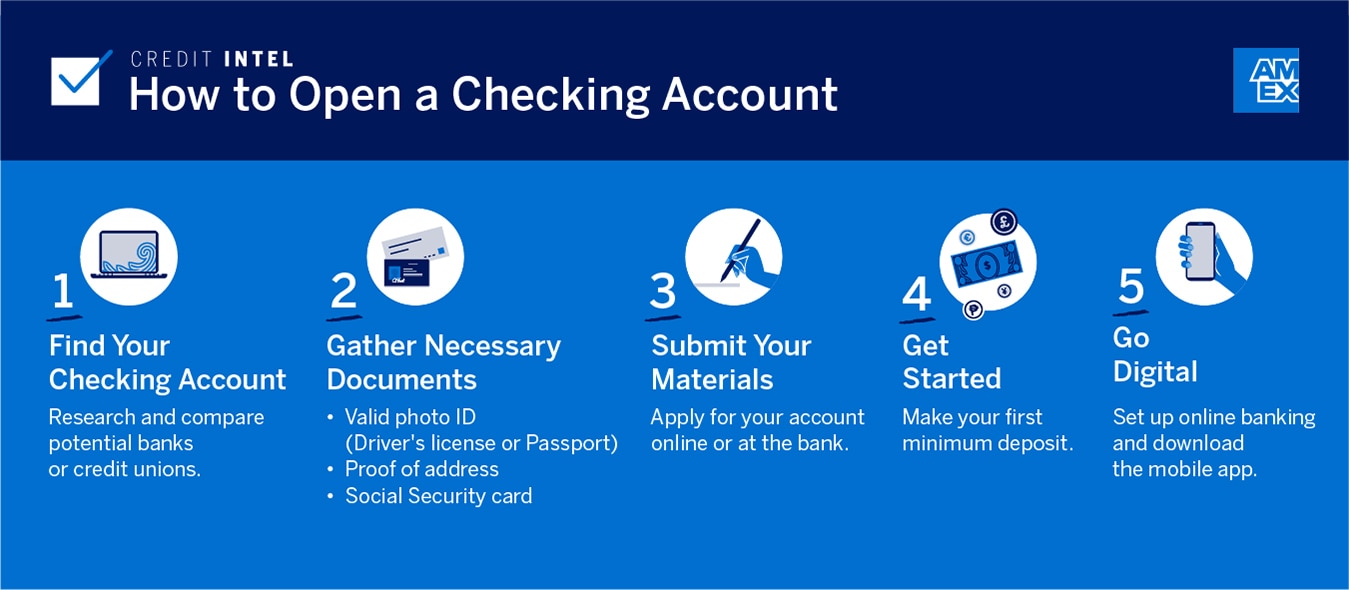
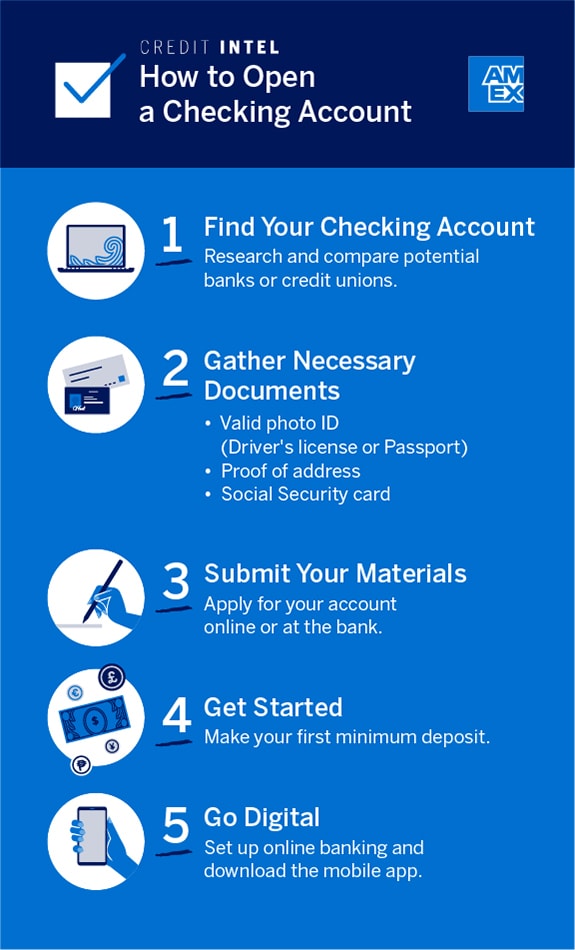
How to Open a Checking Account in 5 Steps
The process varies slightly by bank, but here's the standard playbook.
- Shopping Around Like You Mean It
Not all checking accounts are created equal, and you can compare features before committing to one:- Minimum Balance Requirements
You can find banks that don’t require them, even when they earn interest.
- Monthly Maintenance or Overdraft Fees
Overdrafts occur when your account doesn't have enough funds to cover a transaction that still goes through, sometimes resulting in your bank charging a fee. Maintenance fees, on the other hand, can often be waived if you keep a specific minimum balance. True no-fee checking accounts do exist, as well. Many banks now offer them with no minimum balance or maintenance fees.
- ATM Network Size
Smaller ATM networks may mean more out-of-network fees, although some banks may waive them at the end of each month.
- Mobile App Quality
Some of the best accounts offer seamless banking apps that make managing and enjoying your account simple and fast.
- Whether It Earns Interest
While interest-bearing accounts may be costlier to manage, they can help your money work harder for you in the background.
- Minimum Balance Requirements
- Gathering Your Docs
See the checklist above. Snap photos of your ID and proof of address with your phone—many online applications let you upload them right from there. - Submitting Online or Applying in Person
Before signing, it’s smart to review the account agreement for all information on fees, wire transfer costs, and other account requirements. Don’t feel shy about asking questions, either: A knowledgeable banker should be able to answer them clearly.
Once you’re all up to date, you can open a checking account in person or online. Most banks let you apply in minutes from your phone or laptop. You'll fill in your personal details, upload documents, and verify your identity (sometimes via a quick video or security questions).
- Getting Started
Once approved, you'll typically need to deposit money, often via cash or check deposit, an electronic transfer from another account, or through setting up direct deposit with your employer. If there's a minimum deposit, you may want to reach it within the bank's specified time window—otherwise, your account could close before it really gets going. - Going Digital
With your account up and running, you can download your bank’s mobile app and manage your money right from your device. You can also opt into receiving electronic alerts, updates, letters, and other bank correspondence to streamline communication.
5 Tips, Tricks, and Hacks for Smarter Checking
Once your account is live, these moves can help you squeeze more value out of it.
- Taking Advantage of Sign-Up Bonuses
Plenty of banks offer cash bonuses of $100 or more for opening a new checking account and meeting requirements, like setting up direct deposit or depositing a certain amount of cash.3 - Automating Whatever You Can
You can set up direct deposit so your paycheck is deposited into your account automatically. Other options include scheduling auto-transfers to your savings account on every payday—an effective saving approach that can help you put money away with minimal effort. - Stacking Multiple Accounts Strategically
You can absolutely have more than one checking account. Some people may have one just for bills and fixed expenses, while others may have one for dining out or shopping. Keeping separate accounts for certain transactions may make monthly budgeting feel more organized. - Enabling Alerts
Low-balance alerts, large-transaction alerts, login alerts: intuitive banking apps often let you switch them all on. They're typically fast and free—or included in your maintenance fees—and they can be a first line of defense against fraud. Your bank may even have identity theft monitoring services you can use. - Keeping a Balance Buffer
Just to be on the safe side, you can aim to keep one to two months of expenses parked in your checking account at all times, to cover unexpected expenses without putting you into overdraft territory.
Frequently Asked Questions
Yes, international students can typically open a checking account in the United States. You'll usually need a passport, an ITIN (if you don't have an SSN), proof of U.S. address, and your student visa or other necessary immigration forms. Some banks have specific student-friendly accounts with lower or no minimum requirements, so it can be worth it to shop around.
No, you don't need $200 to open a checking account at all banks. Many institutions allow you to open an account with much less, while others require no minimum opening deposit at all. The $200 figure may be getting confused with promotional welcome bonuses, where banks pay you $200 (perhaps more, perhaps less) for opening an account and meeting certain conditions.
Not necessarily, but it depends on your financial institution. For large amounts, you may need to give your bank advance notice, and even then, your daily ATM withdrawals are usually capped between $500-$5,000.4 Also, under the Bank Secrecy Act, your bank must report any cash transaction (including withdrawals) of $10,000 or more to the Internal Revenue Service (IRS) as part of standard reporting.5
Many online banks and some traditional banks offer checking accounts with no monthly maintenance fees, no minimum balance requirements, and no overdraft fees. You can look for accounts marketed as fee-free and read the disclosures carefully—again, some accounts may only waive fees if you meet conditions like direct deposit or a minimum balance.
The Takeaway
Opening a checking account is one of the simplest, smartest moves you can make for your financial life. All it takes is getting your documents in order, comparing a few options, and picking the account that fits how you actually bank. Once it's open, you can automate your deposits, turn on alerts, and consider stacking a second account to make budgeting more seamless. Explore different types of checking accounts, including rewards checking, to learn more.
1 “10 best high-yield online checking accounts for April 2026: Earn up to 6.75% APY on your balance,” Yahoo! Finance
2 “How to open a bank account: a step-by-step guide,” Bankrate
3 “Best checking account bonuses of April 2026,” CNBC
4 “Daily ATM withdrawal limits: How much money can you take out?,” Bankrate
5 “The Bank Secrecy Act,” Financial Crimes Enforcement Network


Bradley Schnitzer is a writer and email strategist who has covered personal finance and small business topics for over five years. He is passionate about personal finance and helping others understand their money.
All Credit Intel content is written by freelance authors and commissioned and paid for by American Express.