


June 27, 2023
Your Go-To Guide to Contactless Payments
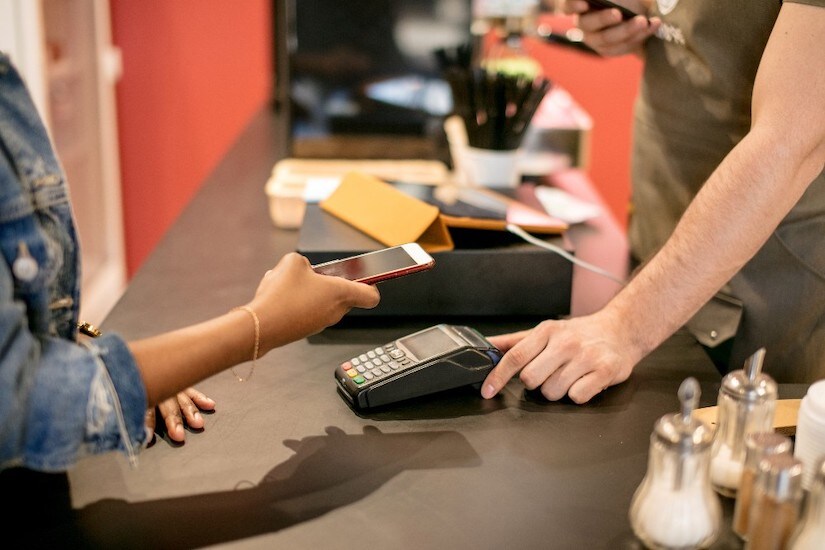
Although contactless payments have been around for years, they’re starting to gain traction in the United States now. Let’s discuss the technology behind these payments!
The Basics of Near Field Communication
Contactless payments are made possible thanks to Near Field Communication (NFC), a short-range wireless technology that enables two devices to communicate with each other. Similar to Bluetooth connectivity and WiFi, NFC works by sending information via radio waves from one NFC-compatible device to another. The device transmitting data, for example: a smartphone or credit card, is classified as “NFC active” and the device receiving data, usually a payment terminal, is “NFC passive.”
Modern-day NFC technology builds on Radio Frequency Identification (RFID), which was patented in 1983. Even after RFID was introduced to the world, it took a few years for it to be picked up and tweaked into NFC technology. In 2004, the NFC Forum was launched by mobile communications, semiconductor, and consumer electronics companies to advance NFC technology. This forum helped to spread the word about the technology, enabling contactless payments and other NFC-enabled functions to further develop.
The Future of Payments
Before the pandemic, contactless payments were slowly gaining popularity in America. Fast forward to today, and this payment method has become a common option for many consumers. Despite the slow adoption in the United States prior to COVID-19, countries like New Zealand, Australia, Singapore, Hong Kong, the Philippines, and many European countries have been using this payment method for years. The world is going contactless for a multitude of reasons:
- Security: In order to complete a contactless transaction, a unique one-time code is generated and sent to the payment terminal. The code doesn’t contain card information, so even if it’s compromised, it would be difficult to make further purchases using it without the credit card or other information.
- Faster: Chip payments take longer to process when compared to contactless transactions.
This article was adapted from Celero.
Learn More About Celero